

 Quick start
  Download
  Manual
  How to buy
  Contact
  Sign in

SMS Network Architecture and Internal Protocols
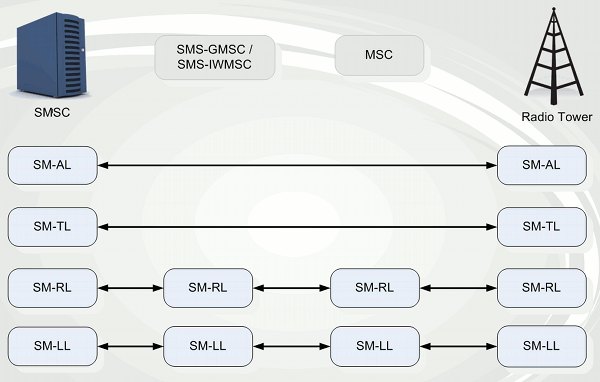
In the SMS network operated by GSM service providers four layers of transport is used (Figure 1.):
SM-AL (Application Layer)
SM-TL (Transfer Layer)
SM-RL (Relay Layer)
SM-LL (Lower Layers)
Ozeki Message Server is located in the SM-AL layer. When sending an SMS the software creates protocol data units (PDU's) transported by the SM-TL layer. When a GSM phone attached to the PC receives an SMS, the message is also encoded according the SM-TL layer PDU specification. Ozeki Message Server decodes this PDU and makes the message readable for computer programs and computer users.
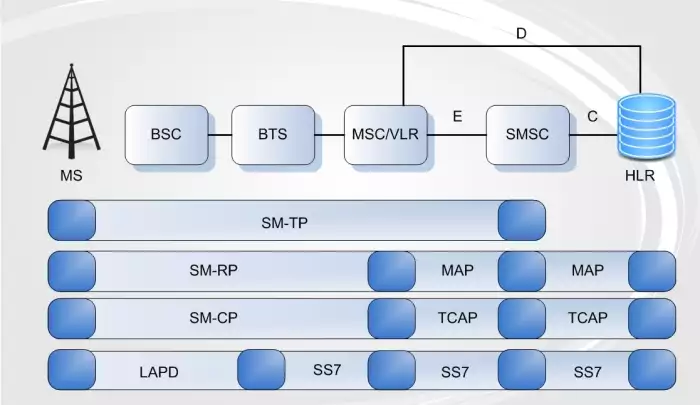
To understand how the SMS travels from the mobile phone to the SMSC please take a look at Figure 2. On this figure you can see which protocols are used and which GSM network entities take place in the communication process. As you can see, the mobile phone (Mobile station) transmits the SMS message to the GSM base station (BTS) through a wireless link. After this the message goes through the backbone network of the service provider. The Mobile Switching Center (MSC), the Home Location Register (HLR) and optionally the Visitor Location Register (VLR) is used to find out the appropriate Short Message Service Center (SMSC) that will store and forward the message when the receiving party becomes available.
More information
- SMS Network architecture
- SMS message types